
The Invisible Alarm: Why Every Light Sleeper Needs an Air Quality Monitor
You spend a third of your life in a room you can’t see. Well, you can see the walls and the dresser and that pile of laundry you’ve been ignoring since Tuesday, but you can’t see the air. And for a light sleeper, what you can't see is usually what’s waking you up at 3:00 AM.
Most of us approach sleep like a construction project. We buy a firmer mattress. We hunt for the perfect pillow. We buy blackout curtains that could stop a solar flare. But after all that, we still wake up with a scratchy throat, a mild headache, or that strange, restless feeling that we just can’t shake. We blame the neighbor’s dog or a stressful work email. But the real culprit is often the chemical composition of the air swirling around your nose. The environment is the invisible hand that shapes human behavior—and in the bedroom, it is the hand that either cradles you or pushes you awake.
If you’re a light sleeper, your brain is essentially a high-alert security guard. It’s looking for reasons to wake you up. An air quality monitor is the tool that finally gives that guard a rest. It turns vague guesses into bedroom data you can actually use to optimize your biological recovery. When you measure the environment, you stop fighting against invisible friction and start designing a system for success.
The High Cost of Invisible Friction
In habit formation, friction is the thing that stops you from doing what you want. In your bedroom, friction is anything that pulls you out of deep REM sleep. For a light sleeper, friction isn't just a loud noise; it's a spike in Carbon Dioxide (CO2) or a sudden drop in humidity that irritates the airway.
Think of your bedroom air like a pool. If the water is the right temperature and clean, you can float forever. If it gets too acidic or too hot, you’re jumping out. Your lungs feel that same "acidity" when CO2 levels climb. Most people sleep with the door closed for privacy or noise reduction. The problem? You’re essentially sealing yourself in a box. Within four hours, the CO2 levels in a standard closed bedroom can double, reaching levels that a Harvard study linked to decreased cognitive function and disrupted sleep.
When the air gets "stuffy," your body’s survival instinct kicks in. Your heart rate increases slightly. Your breathing deepens. You toss and turn. You aren't awake because of a nightmare; you’re awake because your brain thinks you’re running out of fresh air. This is why having an air quality monitor is a game-changer for anyone obsessed with sleep tracking. It identifies the biological trigger before you wake up exhausted.
The Three Metrics That Actually Matter
You don't need a PhD in atmospheric science to fix your sleep. You just need to watch three specific numbers on your monitor to understand how your bedroom data correlates with your rest quality. By managing these inputs, you control the output of your energy the next day.
1. Carbon Dioxide (CO2): The Silent Suffocator
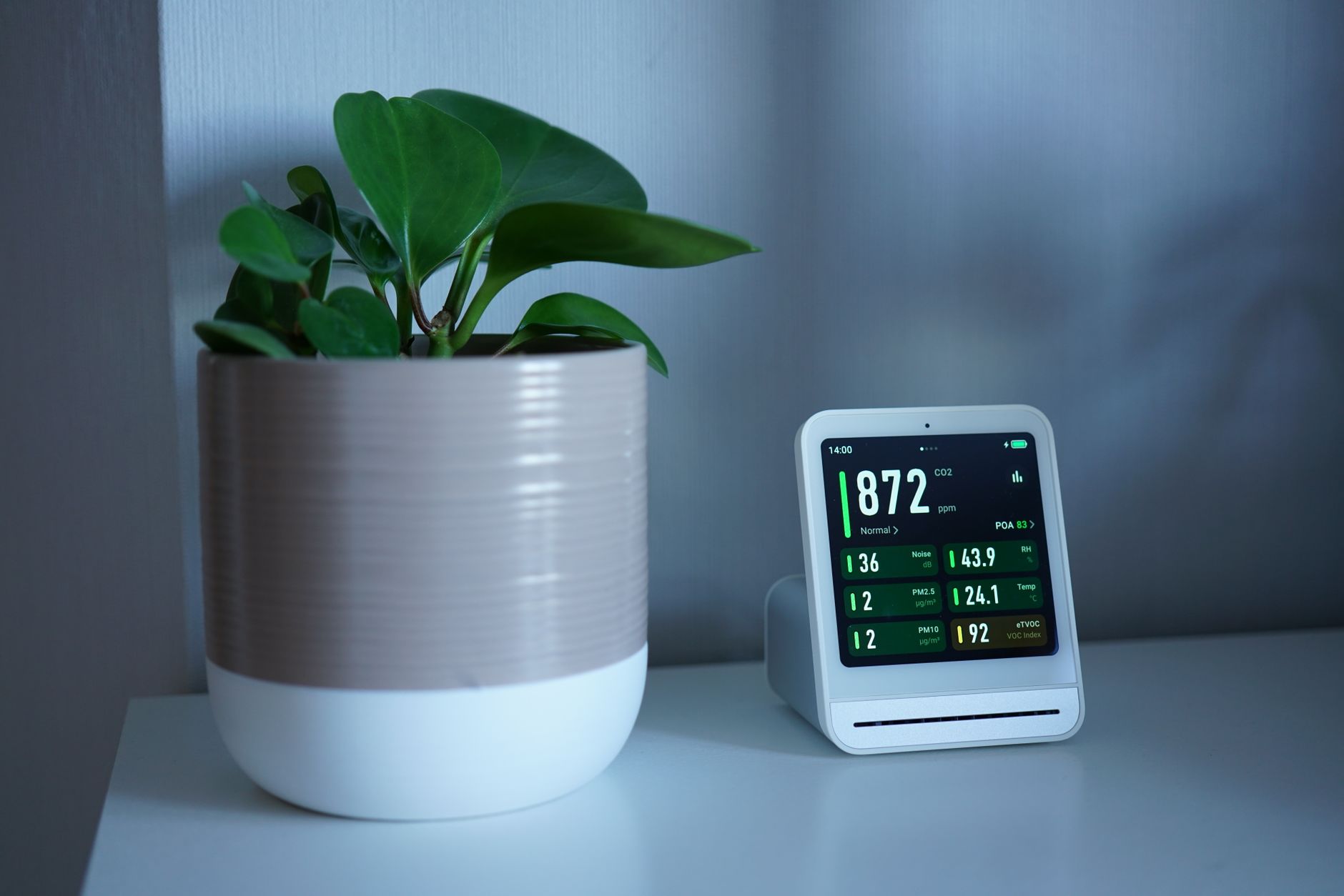
This is the primary "stuffiness" metric. Outdoor air is around 400 ppm (parts per million). In a closed bedroom, I’ve seen it hit 2,000 ppm by sunrise. If your monitor shows you’re crossing the 1,000 ppm threshold, it’s time to crack a window or leave the door an inch open. It’s a tiny shift that can save you hours of restlessness. High CO2 doesn't just wake you up; it reduces the time you spend in deep restorative stages, meaning even if you sleep for 8 hours, you wake up feeling like you only got 4.
2. VOCs (Volatile Organic Compounds): The Chemical Ghost
These are the invisible gases off-gassing from your mattress, your new rug, or even the scented candle you lit earlier. For a sensitive sleeper, these are low-level irritants. They keep your immune system "on," which prevents you from dropping into the deepest stages of sleep. If you detect high VOCs, it might be time to switch to natural cleaners or invest in a device like the 1.5L Wireless Humidifier & Aroma Diffuser which allows you to use pure essential oils for a cleaner scent profile without the synthetic VOCs of paraffin candles.
3. Humidity: The Respiratory Sweet Spot
This is where most light sleepers fail. If the air is too dry (below 30%), your nasal passages dry out, you snore more, and you wake up thirsty. If it’s too humid (above 60%), you sweat and mold begins to thrive. The sweet spot is 40-50%. If your monitor shows you're living in a desert, you need to add moisture back into the system with precision. Humidity is the lubricant for your respiratory system; without it, every breath is a micro-irritation.

Why Guess When You Can Measure?
I’m a big fan of the saying, "We do not rise to the level of our goals, we fall to the level of our systems." If your goal is "better sleep," that’s too vague to be actionable. If your system is "keep bedroom CO2 under 800 ppm and humidity at 45%," that’s a recipe for repeatable success. An air quality monitor acts as the feedback loop for this system. It tells you if your efforts—like opening a window or running a humidifier—are actually moving the needle.
For instance, you might think you need a massive industrial humidifier, but your bedroom data might show that a targeted, smart device is plenty. If you have a larger space or want more control over the direction of moisture, you might look into the 2.5L Quiet Humidifier, which offers 5 mist levels and 3 nozzles to ensure your specific breathing zone is perfectly hydrated without soaking the rest of the room.
The Impact of Particulate Matter (PM2.5)
Beyond gases and moisture, there is the issue of physical particles. PM2.5 refers to particles smaller than 2.5 micrometers. These are small enough to enter your bloodstream through your lungs. Common sources include dust mites, pet dander, and outdoor pollution that leaks in. For a light sleeper with allergies, PM2.5 is a 3:00 AM alarm clock. It causes the nasal tissues to swell, leading to restricted airflow and "micro-awakenings" that you might not even remember, but which leave you groggy. Monitoring this metric tells you when it's time to wash your bedding or upgrade your air purifier.
Advanced Sleep Tracking: Linking Air to REM
Many people use a smartwatch for sleep tracking, but those devices only tell you *how* you slept, not *why* you slept that way. By syncing your sleep stages with your air quality monitor logs, you can find incredible correlations. You might notice that your deep sleep percentage drops every time the room temperature rises above 70 degrees or when the humidity falls below 35%. This is the transition from passive observation to active environmental engineering. When you control the variables, you control the outcome.
In my experience, the most revealing data comes from the interaction between humidity and Heart Rate Variability (HRV). When the air is too dry, your body has to work harder to humidify the air you inhale. This metabolic tax lowers your HRV, meaning your nervous system is more stressed during the night. By introducing a device like the 1.5L Rechargeable Humidifier, you alleviate that respiratory stress, allowing your body to focus on repair rather than maintenance.
The Environment as a Feedback Loop
In the world of habit design, we often talk about the "Cue, Craving, Response, and Reward." But in the bedroom, the loop is more biological. The air quality (the environment) is the cue. Your body's response—elevated heart rate, thirst, or shallow breathing—is the outcome. If you aren't monitoring the air, you are missing the most important cue in the entire cycle.
Consider the "3:00 AM Thirst Trap." You wake up with a parched mouth. You think you need a glass of water. But the thirst isn't the problem; it's a symptom of 22% humidity in your bedroom. You drink the water, go back to sleep, and wake up again at 5:00 AM because now your bladder is full. This is a cascade of poor sleep caused by a single unmeasured variable. An air quality monitor breaks this chain by alerting you to the low humidity before you ever feel the thirst.
Designing the Night: A Checklist for the Optimized Bedroom
Once you have your monitor, you can begin the process of "Bedroom Auditing." This isn't about perfection; it's about reducing the number of reasons your brain has to wake you up. Here is how you should structure your environment based on the data you collect:
- The 9:00 PM Purge: Open your bedroom window for 10 minutes before bed. This flushes the accumulated VOCs and CO2 from the day, giving you a "clean slate" of air to start the night.
- Zone-Specific Hydration: Use a compact device. Because it's often more efficient to humidify the area directly around your face, a wireless option can be placed exactly where it matters most—within two feet of your head.
- The Dust Defense: If your monitor shows high particulate matter, it’s a sign your HVAC filter is failing or your rug is a dust trap. This is a primary trigger for the common "3:00 AM stuffy nose."
- The Sensory Deprivation Layer: Once the air is fixed, handle the light. I'm a huge proponent of the 3D Sleep Mask. The 3D contouring means zero pressure on your eyes, completing the sensory isolation.

"Small changes in environment lead to big changes in results. You don't need more willpower to sleep through the night; you need a better room."
Related Reading for the Data-Driven Sleeper
- Carepod vs Dyson Humidifier: Which One Is Better for Clean Air & Sleep? (2026)
- The Saharan Bedroom: Why Your Sleep Environment is a Biological Miscalculation
- The Invisible Threshold: Why Your Minimalist Bedroom is the Key to Mental Clarity
- The Geometry of Darkness: Why the Best Eye Mask for Side Sleepers is 3D Contoured
- The Desert in Your Bedroom: How Humidity and Health Impact REM Sleep
- How to Stop Bedroom Allergens for Better Breathing & Clean Air
Actionable Steps for Tonight
If you’re ready to stop guessing and start sleeping, here is your 3-step plan to integrate an air quality monitor into your routine:
- Audit the Air: Place an air quality monitor on your nightstand (not across the room). You want to measure the air you are breathing, not the air the bookshelf is breathing. Record your baseline for three nights.
- The Door Crack Experiment: If your CO2 levels are high, try sleeping with the door open just two inches. Check your sleep tracking data the next morning. You’ll likely see a significant drop in those middle-of-the-night micro-awakenings.
- Balance the Moisture: If your humidity is below 40%, get a quiet humidifier. If you’re looking for a versatile option, the 2L Dual Spray Humidifier is excellent because the LED display gives you an immediate visual cue of the room's status.
FAQ
Does an air quality monitor actually help me sleep?
It doesn't put you to sleep, but it identifies the things that wake you up. Think of it like a coach. A coach doesn't run the race for you, but they tell you where your form is breaking down so you can fix it. If your monitor shows a VOC spike every time you use a certain cleaning product, you now know how to remove that friction from your life.
Where is the best place to put the monitor?
The best place is at "breathing level," which is usually the height of your pillow. Placing it on a nightstand within 3 feet of your head provides the most accurate data regarding what your lungs are actually processing during the night.
Can high CO2 cause nightmares?
While not a direct cause, high CO2 leads to lighter sleep and more frequent awakenings. When you wake up frequently during REM sleep, you are much more likely to remember vivid or stressful dreams, leading to the perception of having more nightmares.
How often should I check my bedroom data?
I recommend checking it once a morning for the first week. Look for patterns. Did you sleep better when the humidity was 45%? Did you have a headache when the CO2 hit 1,500 ppm? Once you establish your ideal "sleep recipe," you only need to check it if your sleep quality starts to dip again.
What is the difference between PM2.5 and VOCs?
PM2.5 refers to tiny physical particles (like dust, smoke, or pollen) floating in the air. VOCs are gases (like chemical fumes from paint or hairspray). Both can irritate a light sleeper, but they require different solutions—PM2.5 usually needs an air purifier, while VOCs and CO2 need better ventilation.
Is 50% humidity too high for a bedroom?
No, 50% is actually the top end of the "ideal" range. Most experts suggest staying between 40% and 50%. Once you cross 60%, you run the risk of encouraging dust mites and mold growth, which can cause allergies that keep you awake.
Can an air quality monitor detect mold?
Indirectly, yes. Most monitors don't "see" mold spores, but they track high humidity and VOC levels. Mold produces Microbial Volatile Organic Compounds (mVOCs), which will show up as a spike in the VOC reading on your device.
What is the ideal CO2 level for deep sleep?
Ideally, you want to keep your bedroom CO2 levels below 800 ppm. Levels above 1,000 ppm are when most people start to experience restlessness, and levels above 1,500 ppm are highly correlated with morning headaches and poor cognitive performance.
Does air quality affect deep sleep vs REM sleep?
Yes. High CO2 levels have been specifically linked to a reduction in deep sleep (Slow Wave Sleep). Poor air quality tends to keep the brain in a state of "arousal," which keeps you in the lighter stages of sleep rather than the restorative deep stages needed for physical recovery.